Page Contents
- What is Maharashtra Rent Control Act 1999?
- Standard Rent As Per Maharashtra Rent Control Act 1999
- Rent Increasing Rules As Per Maharashtra Rent Control Act 1999
- Penalty Rules as per Maharashtra Rent Control Act 1999
- Chapter 1 of Maharashtra Rent Control Act 1999
- Section 12 of Maharashtra Rent Control Act 1999
- Section 17 of Maharashtra Rent Control Act 1999
- Section 38 of Maharashtra Rent Control Act 1999
- The Model Tenancy Act vs. Maharashtra Rent Control Act
- FAQs
What is Maharashtra Rent Control Act 1999?
The Maharashtra Rent Control Act 1999 combines the law related to renting, repair work of premises, encouraging new house construction, and related aspects of it.
The Act aims to regulate rent, repairs, and eviction while also ensuring a fair return to landlords.
It further works to reduce disputes between landlords and tenants regarding rent, repairs, and possession of premises.
The whole act is classified into 60 sections divided into 9 chapters and 2 Schedules.
Standard Rent As Per Maharashtra Rent Control Act 1999

As per the applicability of the Act, charging rent above the standard rent and permitted increases is unlawful under the Act.
If this is done by the landlord, then he/she will be punished with imprisonment for up to three months or a fine up to Rs. 5000 or both.
Rent Increasing Rules As Per Maharashtra Rent Control Act 1999

The Act specifies that landlords are allowed to increase the rent by 4 percent per annum for their rented property.
For improvements or structural alterations made with tenant consent, the landlord may seek a reasonable increase. For special additions, special alterations, additional amenities, or similar work, the increase cannot exceed 15% per year of the expenses incurred.
If the landlord has to pay increased rates, cess, taxes, charges, land assessment, ground rent, or higher electricity or water charges, the landlord may increase the rent only up to the actual additional amount paid.
Penalty Rules as per Maharashtra Rent Control Act 1999
As per the Maharashtra Rent Control Act 1999, various penalty rules are mentioned for various reasons. The below-mentioned are the penalties as the Act specifies.
|
Penalty as per the Maharashtra Rent Control Act 1999 |
|
| Excessive Rent Charged | Imprisonment up to three months
Or fine up to Rs. 5000 Or both |
| Rent Agreement Not Registered | Imprisonment up to three months
Or fine up to Rs. 5000 Or both |
| Residential Properties Used for Commercial Purpose | Imprisonment up to six months
Or fine up to Rs. 10,000 Or both |
| Rent Receipt Not Provided to Tenants | Fine for each day will be upto Rs. 100 |
| Disconnectivity of Essential Services | Imprisonment up to three months
Or fine up to Rs. 1000 Or both |
Chapter 1 of Maharashtra Rent Control Act 1999
Chapter 1 covers various sections which clarify about an application, exemption, cessation of exemption and many more under the Maharashtra Rent Control Act 1999.
Section 1: Title, Extent & Commencement
This act applies to the whole of Maharashtra state.
Section 2: Application
The Maharashtra Rent Control Act 1999 is specifically applicable for residential, educational, business, trade, and storage purposes.
This act will also apply to the areas or premises where the following acts were applied before.
- Bombay Rent, Hotel & Lodging House Rates Control Act, 1947
- The Hyderabad House Control Act, 1954
- The Central Provinces and Berar Letting of House and Rent Control Order, 1949
- The Central Province and Berar Regulation of Letting of Accommodation Act, 1946
Section 3: Exemption
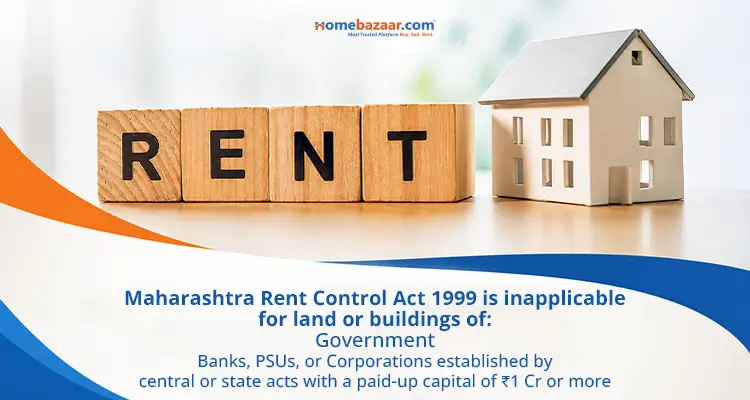
The Maharashtra Rent Control Act 1999 is not applicable for:
- Usability of land or building by the government. However, if the government provided land or building to someone on basis of a license, then this act will be applicable.
- Banks, Public Sector Undertakings, or Corporations established by central or state acts with a paid-up capital of ₹1 Crore or more.
- Premises belonging to a public trust registered under the Maharashtra Public Trusts Act, 1950, may be exempted only if the State Government issues a specific notification in the Official Gazette to that effect.
- Premises let or sub-let to private limited and public limited companies having a paid-up share capital of rupees one crore or more.
State Government can issue a general or special order on a timely basis regarding the changes in the exemption provided to a local authority.
Section 5: Cessation of Exemption
The State Government may withdraw an exemption if the conditions attached to that exemption are violated.
However, State Government will provide an opportunity to the local authority, religious or charitable institutions to prove why not to issue such an order and why not take the necessary action.
Section 6: Conditions Regarding The Inapplicability of Standard Rent on Premises
This section specifies the inapplicability of standard rent on certain premises.
- As per Section 6, the provisions relating to standard rent do not apply to premises newly constructed or premises that have not been let out for a continuous period of one year prior to the commencement of this Act.
- This act can be applied if the premises is been constructed or reconstructed under any housing scheme.
You can check out the Maharashtra Rent Control Act 1999 to know more about every rule, penalty, and sections.
Section 12 of Maharashtra Rent Control Act 1999

Increase in rent over the payment of rates, cess, tax, charges, etc
- The landlord pays various cess, tax, charges, land assessment, and many more to the government. This is paid for his/her premises.
- If the landlord paid the increased government tax, then he/she can increase the rent with the same increased tax paid amount.
- If a rental agreement explicitly includes electricity and water charges within the rent amount, the landlord is entitled to increase the rent by an amount equal to any rate hikes imposed by utility authorities.
Then he/she can increase the same amount in the rent value as well.
Section 17 of Maharashtra Rent Control Act 1999

Recovery of possession for repairs and re-entry
a) The court of law will seek the tenant regarding his/her opinion on living in the premises during repair work. As the tenant decides to shift to other premises or to live in the same premises.
b) The landlord will need to provide the notice to the tenant just before the 2 months of completion of repair work. The notice will specify that the tenant can take possession once the repair work is done.
Whereas the tenant should provide his/her acceptance within 30 days of getting the notice from the landlord. The tenant will also have to deposit the rent or security amount as determined by the court.
Once the acceptance and one-month rent amount is received from the tenant, the landlord can provide possession to the tenant.
If the tenant fails to provide the same then the landlord can terminate the tenant’s right to occupy the premises.
c) The tenant has to hand over the possession to the landlord for repair work.
In the following scenario
- And even after one month, the landlord did not begin the repair work
- The repair work is not done as needed
- The landlord didn’t provide possession to the tenant even after the completion of the repair work.
Within 1 year of knowing any of these scenarios, the tenant has to provide an application to the court mentioning the whole situation.
Then the court of law will make the landlord provide the repaired premises to the tenant.
d) If the landlord fails to comply with the court order, they will be punished with imprisonment for a term up to three months, or a fine up to Rs. 1,000, or both.
Section 38 of Maharashtra Rent Control Act 1999

Time limit for disposal of suits, proceedings, or appeals
- As per this act, the time limit for disposal of suits or proceedings of a case is within 12 months from the date of service of summons on the defendant.
- The time limit for disposal of appeals is within 6 months from the date of service of notice of appeal on the respondent.
The Model Tenancy Act vs. Maharashtra Rent Control Act

While the Central Government pushed for the adoption of the Model Tenancy Act in 2021, Maharashtra continues to stick firmly with its robust Maharashtra Rent Control Act, 1999, to protect its massive existing base of urban tenants.
The Model Tenancy Act focuses on balancing the rights of landlords and tenants. And to provide transparency in renting deals with efficiency.
However, the Maharashtra Rent Control Act 1999 is already in place and has proven helpful to over 6 to 7 lakh tenants in the state.
And implementing the new act will be contradictory to the rentals.
So, the Maharashtra government is not ready to implement the Model Tenancy Act as of now.
You can check out the important rent deposit rules of the Model Tenancy Act to know about rent deposit and refund rules under this act.
FAQs
| What is the penalty to the landlord for overcharging the rent?
If the landlord charges rent more than the standard rent, then he/she will come under the penalty of imprisonment for up to 3 months or a fine up to Rs. 5000, or both. This is stated in the Maharashtra Rent Control Act 1999. |
| What is the rent-increasing criteria as per The Maharashtra Rent Control Act 1999?
The Maharashtra Rent Control Act 1999 Act specifies that landlords are allowed to increase the rent by 4% per annum for their rented property. |
| What is the status of the Model Tenancy Act in Maharashtra?
While the Central Government approved the Model Tenancy Act in June 2021 as a guideline for states, the Maharashtra government decided to stick firmly with its existing Maharashtra Rent Control Act, 1999, to protect its current urban tenant base. |