Page Contents
- What Is FSI in Thane? How Does It Affect The Value of Property?
- Importance of FSI in Thane
- What are the New FSI Rules in Thane 2026?
- How To Calculate FSI In Thane?
- What Is FSI For Residential Buildings In Thane?
- Premium FSI Charges in Thane
- What is Permissible FSI in Thane
- Impact of FSI on Thane’s Real Estate Landscape
- FAQs
What Is FSI in Thane? How Does It Affect The Value of Property?
FSI stands for Floor Space Index, which is a measurement of the total area of a building that can be constructed on a given plot of land.
In Thane, FSI is regulated by the local government and is used to determine the maximum permissible construction on a plot or land.
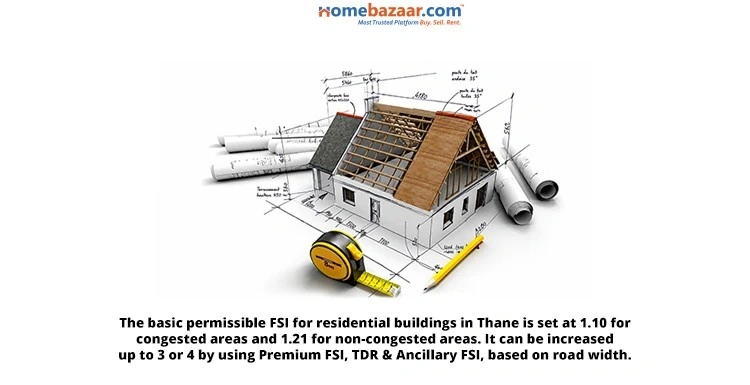 Under the UDCPR, the basic permissible FSI in Thane is 1.10 for congested areas and 1.21 for non-congested areas, which can be further loaded using Premium FSI and TDR, depending on the road width.
FSI affects the value of property in Thane in several ways:
- Firstly, a higher FSI allows for greater construction in the city and can increase the usable area of a building, thereby increasing its value.
- Secondly, a higher FSI often leads to the development of better infrastructure, such as improved roads, water supply, and public transport, which can increase the value of property in the area.
- Additionally, a lower FSI may limit the potential for development and can lead to higher demand for existing properties, driving up their value.
It is important to note that FSI regulations can be complex and vary from location to location.
Importance of FSI in Thane
FSI is an important factor in the development of real estate in Thane.
FSI regulates the maximum permissible construction on a plot of land and is determined by the local government.
 Here are some of the key reasons why FSI is important in Thane:
Optimal utilization of land: FSI ensures that the available land is utilized to its fullest potential. By setting limits on the amount of construction that can be done on a plot of land, FSI helps to ensure that land is not wasted or underutilized.
Control over urbanization: FSI is used by the government to control the rate and scale of urbanization in Thane. By regulating the amount of construction that can be done, FSI helps to maintain a balance between development and environmental concerns.
Promotes affordable housing: FSI can be used to promote affordable housing by allowing for the construction of smaller units in the same amount of space. This can help to meet the housing needs of low-income families and individuals.
Improved infrastructure: FSI regulations often require developers to provide infrastructure such as roads, water supply, and public transport. This can lead to the development of better infrastructure in Thane, which can benefit the local community.
What are the New FSI Rules in Thane 2026?
In December 2020, the Maharashtra state government implemented the Unified DCPR (UDCPR) across the state, excluding Mumbai, to standardise building regulations. Eknath Shinde, the urban development minister, published specific regional updates for the Thane Municipal Corporation area to streamline local development.
Under the UDCPR rules, the redevelopment of old, authorized dilapidated buildings is heavily incentivised with additional FSI over the basic requirement to make projects financially viable for developers
High-rises can be built in Thane as the UDCPR allows buildings to exceed 70 metres, subject to special High-Rise Committee approvals, plot size, road width, and stringent fire safety clearances.
Due to the need for more FSI or TDR for crowded neighbourhoods, the majority of redevelopment projects in this section of the city have stopped. Maximum FSI cannot be utilized on narrow roads; in fact, no Premium FSI or TDR loading is permitted on roads less than 9 metres wide, restricting construction strictly to the basic FSI.
How To Calculate FSI In Thane?
In Thane, the calculation of FSI is governed by the state-wide Unified Development Control and Promotion Regulations (UDCPR).
To calculate FSI in Thane, you will need to consider the following factors:
The total area of the plot of land
The permissible basic FSI and potential loading limits as mandated by the UDCPR rules
The built-up area of each floor
The formula to calculate FSI in Thane is:
FSI = Total built-up area of all floors / Total area of the plot of land
For example, let’s say the total area of the plot of land is 1,000 square metres and the total permissible FSI (including premium additions) is 2.0.
This means the developer can construct a total built-up area of 2,000 square metres.
If each floor has a built-up area of 500 square metres, the developer can build a 4-storey structure (2,000 sq.m / 500 sq.m).
The final FSI is: 2,000 sq.m / 1,000 sq.m = 2.0.
What Is FSI For Residential Buildings In Thane?

The Floor Space Index (FSI) for residential buildings in Thane depends on various factors such as the type of property, location, and the zone classification under the Unified DCPR (UDCPR).
As per the UDCPR in Thane, the basic permissible FSI for residential buildings is set at 1.10 for congested areas and 1.21 for non-congested areas. This base value can be loaded up to 3.00 or 4.12 using Premium FSI and TDR, depending entirely on the width of the fronting road.
For large-scale cluster redevelopment and urban renewal schemes (URS) in Thane, the UDCPR allows a total maximum permissible FSI of up to 4.00, subject to specific minimum plot sizes and public infrastructure provisions.
Meanwhile, individual residential layouts on regular plots can scale up to a maximum cap of 4.12 on wide roads by combining basic, premium, and ancillary FSI options.
Premium FSI Charges in Thane

The government will levy a premium fee known as the FSI Premium if you want to enhance the permitted FSI (Floor Space Index).
Premium FSI quantum is determined by road widths measured in metres (9m to 30m+), allowing developers to purchase up to 0.5 or sequential FSI extensions by paying a premium based on local Ready Reckoner rates
What is Permissible FSI in Thane
Permissible FSI (Floor Space Index) in Thane is the maximum ratio of the built-up area of a building to the area of the plot of land on which the building is constructed.
As per the current UDCPR rules in Thane, the permissible FSI for different types of properties are as follows:
Residential & Commercial Plots: Basic FSI of 1.10 for congested areas and 1.21 for non-congested areas (Maximum permissible up to 3.0-4.12 via Premium FSI and TDR loading depending on road width).
Industrial buildings: Basic FSI of 1.0.
IT/ITES buildings: Up to 3.0 to 5.0 FSI (Subject to specific government IT policy incentives and premium fees).
Impact of FSI on Thane’s Real Estate Landscape
FSI (Floor Space Index) is an important factor that affects the real estate landscape of Thane, as it determines the maximum built-up area that can be constructed on a given plot of land.

Here are some of the ways in which FSI impacts Thane’s real estate:
Increase in building height: With a higher FSI, developers can construct taller buildings, which can help increase the supply of housing and commercial space in areas where land is scarce or expensive.
Increase in property values: Higher FSI allows for greater construction, which can increase the overall value of a property. As a result, properties with higher FSI are generally more expensive than those with lower FSI.
More development opportunities: Developers may be more interested in acquiring land with higher FSI, as it allows for more construction and higher returns on investment. This can lead to more development opportunities in areas with higher FSI.
Impact on infrastructure: With more construction and development, there may be a strain on infrastructure such as roads, water supply, and sewage systems. It is important for the government to ensure that infrastructure keeps pace with development.
Impact on the environment: With increased construction and development, there may be a greater impact on the environment. This can include loss of green spaces, increase in traffic congestion and pollution, and strain on natural resources.
Thane is a preferred choice for living amongst homebuyers with many affordable housing options in Thane available to invest in. The requirements are frequently modified under the rules set forth by the government. Homebazaar.com assists in property purchases if you are looking for flats in Thane.
FAQs
| What is FSI in Thane?
FSI in Thane is the maximum ratio of the built-up area of a building to the area of the plot of land on which the building is constructed. |
| What is the permissible FSI for residential buildings in Thane?
Under the UDCPR, the basic permissible residential FSI is 1.10 for congested areas and 1.21 for non-congested areas. Depending on the road width (9 m to 30 m or more), developers can scale this up to a maximum cap of 3 to 4.12. |
| What is the permissible FSI for commercial buildings in Thane?
The basic FSI for commercial buildings in Thane depends on the zoning. In standard residential zones, commercial building footprints match residential baselines (1.10 for congested areas and 1.21 for non-congested areas). However, in designated commercial zones, the basic FSI starts higher at 1.50 to 2.50. Depending on road widths, this can be scaled up to a maximum cap of 4.12 or more using Premium FSI and TDR. |
| How does FSI impact the real estate landscape in Thane?
FSI can impact the real estate landscape in Thane by influencing the height and density of buildings, property values, development opportunities, infrastructure and environmental concerns. |