Disclaimer:
With 11+ years of experience & expertise in the real estate industry, Homebazaar provides end-to-end property-buying solutions. Hundreds of 100% verified RERA-registered residential & commercial properties are listed on our website. We provide facilities like Zero brokerage, 360° virtual street view, effortless site visit services, end-to-end property buying agreements & documentation guidance, and low-interest home loan assistance. This helped us gain the trust of 55,000+ clients across India & sold 6,500+ homes of top reputed developers.
Page Contents
- What Is FSI In Navi Mumbai? How Does It Affect the Value of Property?
- What are the New FSI Rules in Navi Mumbai 2026?
- How to calculate FSI in Navi Mumbai?
- What is FSI for Residential Buildings in Navi Mumbai?
- What is Permissible FSI in Navi Mumbai?
- Importance of FSI in Navi Mumbai
- Impact of FSI on Navi Mumbai’s Real Estate Landscape
- FAQs
FSI (Floor Space Index) is a crucial parameter that determines the extent of construction permissible on a given plot of land in Navi Mumbai.
In simple terms, it is the ratio of the built-up area to the total plot area.
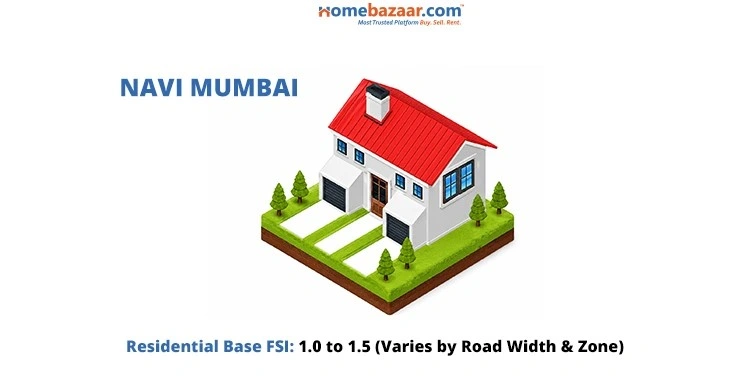
In Navi Mumbai, the base FSI usually ranges from 1.0 to 1.3 and can go up to 1.5 on wider roads. In redevelopment projects, the FSI may increase to around 2.0 to 2.5, depending on the road width.
In Navi Mumbai, FSI regulations are implemented by the City and Industrial Development Corporation (CIDCO) and the Navi Mumbai Municipal Corporation (NMMC) based on the state-wide Unified Development Control and Promotion Regulations (UDCPR).
The FSI limits in Navi Mumbai vary based on the location and zoning of the plot, with higher FSI permitted in commercial areas and lower FSI in residential areas.
The permissible FSI for commercial developments can go up to 5.0 in specific transit-oriented development (TOD) corridors or specialized commercial zones, subject to road width and premium payments.
The FSI has a direct impact on the value of property in Navi Mumbai.
- A higher FSI means that more built-up areas can be constructed on a plot, which can lead to higher revenues for developers and increase the value of the property.
- On the other hand, a lower FSI can limit the amount of construction and development on a plot, which can negatively impact its value.
It is important to note that FSI is not the only factor affecting the property value in Navi Mumbai.
Other factors such as location, infrastructure, amenities, and market demand also play a significant role.
However, understanding the FSI regulations in Navi Mumbai is crucial for property owners and developers to make informed decisions and maximize the potential of their assets.
Note:
Homebazaar serves homebuyers searching for flats in Navi Mumbai with end-to-end services like site visits, and lower-interest home loans to property registration guidance. We provide the best price options & offers for 1 to 4 BHK RERA-registered flats, villas & penthouse properties in Navi Mumbai. To begin a smooth homebuying journey with us, fill out the form mentioned below or on the right side.
The regulations governing housing redevelopment and reconstruction in Navi Mumbai are actively managed under the unified guidelines of the UDCPR.
Here is the table given below that specifies the total permissible FSI.
|
Category / Road Width |
Permissible FSI Potential in Navi Mumbai |
| For plots on roads less than 9 meters wide |
Base FSI is capped at 1.1, and high-rise redevelopment is restricted. |
| For plots on roads 9 meters to 12 meters wide |
Permissible FSI up to 2.0 to 2.5 (including incentive/premium FSI). |
| For plots on roads 12 meters and above |
Maximum permissible redevelopment FSI up to 3.00. |
Parking space requirements in residential developments are explicitly structured around individual tenement sizes, mandating one car parking space per tenement, depending on the designated carpet area slices as per the UDCPR framework.
Exemptions For Open Space
 Under the current UDCPR guidelines:
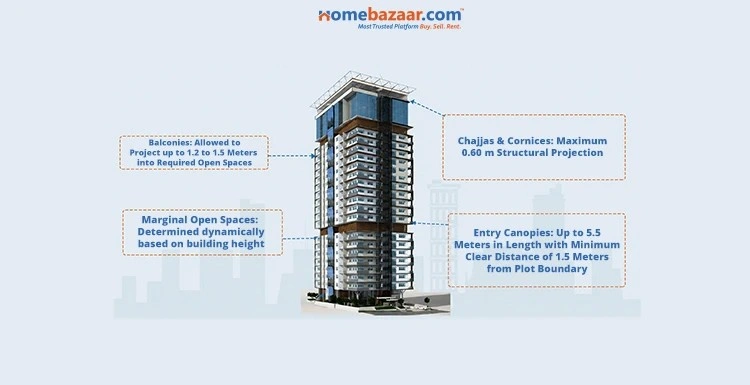
- Balconies are allowed to project up to 1.2 to 1.5 meters into required open spaces, provided they do not reduce the mandatory side margins, which are determined dynamically based on the total height of the building.
- Pocket terraces and decorative projections are permitted under the UDCPR, but their area must be included in the FSI calculation unless they strictly adhere to the designated free-of-FSI architectural features list, with marginal distances verified by the municipal commissioner.
- Architectural projections like chajjas, cornices, and weather shades are permitted to project up to 0.60 meters into mandatory open spaces, which must otherwise remain entirely open to the sky to ensure adequate ventilation and safety compliance.
- Entrance canopies up to 5.5 meters in length are permitted over the main access point, provided they maintain a clear height of 2.4 meters underneath and leave a minimum clear distance of 1.5 meters from the plot boundary.
Calculating FSI in Navi Mumbai requires knowledge of the total area of the plot and the built-up area of the construction on the plot.
Here is the formula to calculate FSI:
|
FSI = (Total built-up area of all floors) / (Total area of the plot) |
For instance, if the overall built-up area of all floors in a building is 5000 sq ft and the total plot area is 2500 sq ft, FSI can be calculated as,
FSI = 5000 / 2500
FSI = 2
This means that the FSI for this building is 2.0, which is the ratio of the built-up area to the total area of the plot.
There may be certain exclusions and exemptions in the FSI calculation, such as for parking spaces or open spaces, which can vary based on the location and zoning of the plot.
Therefore, it is advisable to consult a professional, such as an architect or a real estate consultant, to ensure accurate FSI calculation.
The baseline FSI for residential developments in Navi Mumbai is determined by whether the plot falls within a Congested or Non-Congested area, as defined by the UDCPR.
Here are the FSI in Navi Mumbai for residential developments given below,
| Minimum Width of Road | Plot Size Criteria | Base Permissible FSI in Navi Mumbai |
| Road width below 9 meters | All standard plots | Base FSI capped at 1.10 |
| Road width 9 m to 15 m | Plots up to 1000 sq m | Base FSI starts at 1.10 |
| Road width 15 m and above | Plots above 1000 sq m | Base FSI starts at 1.50 |
For plots situated on roads measuring 9 meters or greater in width, the permissible building potential can be strategically extended through the loading of Premium FSI and Transferable Development Rights (TDR) up to the zone’s absolute cap.
Special height permissions for residential bungalows or independent villas may be granted by the Municipal Commissioner, provided that any double-height lounge spaces comply with the overall volumetric limits set by local building codes.
Under the current UDCPR framework, the basic FSI layout for Navi Mumbai is categorized as follows:
- Congested Residential Areas: Baseline FSI is set at 1.25.
- Non-Congested Residential Areas: Baseline FSI ranges from 1.0 to 1.10, depending on the plot size and regional zoning, which can be further augmented using Premium FSI and TDR according to the width of the fronting road.
- Educational, Medical, and Institutional Buildings: Permissible FSI ranges from 1.50 to 2.50, subject to road width availability and premium fees.
- Industrial Zones: Baseline FSI stands at 1.00 for general industrial development, while service industries are regulated by specific chemical and safety zones.
- Public Amenities and Places of Worship: Allowed a baseline FSI of 1.00 to facilitate community infrastructure, completely replacing the legacy 0.10 FSI limits.
Permissible FSI is a measure of the maximum amount of construction that can be carried out on a particular piece of land.
The Permissible FSI in Navi Mumbai is determined by the NMMC and City and Industrial Development Corporation (CIDCO), which is the planning and development authority for Navi Mumbai.
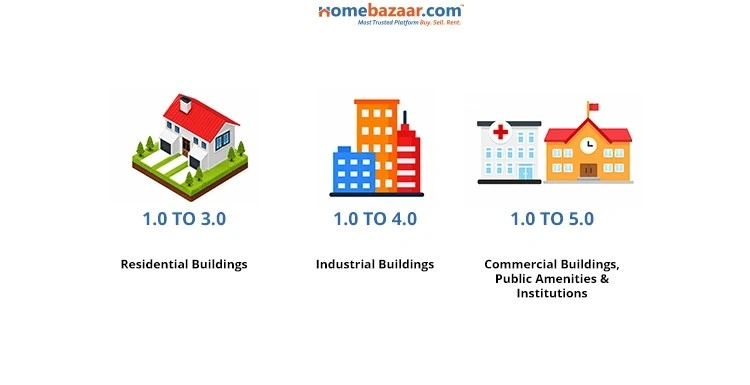
As per the current regulations, the Permissible FSI in Navi Mumbai varies for different types of developments such as residential, commercial, industrial, and public amenities.
As per modern regulations, the maximum permissible building potential can reach up to 3.00 for residential developments and up to 5.00 for commercial layouts through the strategic integration of Premium FSI, Ancillary FSI, and TDR.
Furthermore, developers can optimize project scale by utilizing Ancillary Area FSI up to 60% for residential developments and up to 60% for commercial buildings upon payment of the prescribed premium to the authority.
For critical public amenities and institutional structures like hospitals and schools, the total permissible FSI can expand up to 5.00, depending on the fronting road width and layout approvals.
FSI (Floor Space Index) is an essential parameter that plays a significant role in the development and growth of Navi Mumbai.

Here are some of the reasons why FSI is important in Navi Mumbai:
Optimal land use: FSI determines the extent of construction permissible on a given plot of land. It helps to optimize the use of available land resources and enables the development of buildings that are efficient and sustainable.
Encourages development: FSI regulations in Navi Mumbai encourage the development of the city by permitting higher FSI in certain areas, such as commercial and industrial zones. This leads to increased investment in the city, creating more job opportunities and driving economic growth.
Affordable housing: FSI can help address the issue of affordable housing in Navi Mumbai by allowing developers to build more housing units on a given plot of land. This helps to meet the growing demand for housing in the city, especially for the low and middle-income groups.
Infrastructure development: FSI regulations in Navi Mumbai also consider the availability of infrastructure such as roads, water supply, and sewage systems. The regulations help to ensure that the development is sustainable and that the infrastructure can support the needs of the growing population.
Revenue generation: FSI regulations can also generate revenue for the government by allowing them to charge premiums for additional FSI. The revenue generated can be used for infrastructure development and other civic projects.

The Floor Space Index has a significant impact on the real estate landscape in Navi Mumbai:
- The FSI determines the amount of construction that can be carried out on a particular piece of land, and therefore, it directly affects the supply of housing and commercial space in Navi Mumbai.
- The increase in FSI has led to vertical development and the construction of high-rise buildings in Navi Mumbai, which has helped to meet the growing demand for housing and commercial space in the city.
- The availability of more housing options has also led to an increase in the population density in certain areas.
- Higher FSI has also led to increased construction activity, which has boosted the local economy and created job opportunities in the real estate and construction sectors. This has contributed to the overall growth and development of Navi Mumbai.
FSI has led to increased construction activity and economic growth, there is a need for balanced development and investment in infrastructure to ensure sustainable growth and development of the city.
Also read: FSI in Mumbai.
FAQs
| How much FSI is allowed in Navi Mumbai?
Under the UDCPR framework, the base residential FSI starts at 1.0 to 1.10 and can scale up to 3.00 for residential redevelopment and up to 5.00 for commercial zones and critical public amenities, depending on road width. |
| What is FSI in Navi Mumbai?
FSI stands for Floor Space Index, which is a regulatory tool used in urban planning to determine the maximum permissible construction on a particular plot of land. |
| How is FSI calculated in Navi Mumbai?
FSI is calculated by dividing the total built-up area of a building by the total area of the plot on which it is constructed. The FSI limit varies depending on the zone in which the plot is located. |
| Can the FSI limit be increased in Navi Mumbai?
A: The FSI limit can be increased in certain cases, such as for the redevelopment of old buildings or for the development of public amenities. However, such increases are subject to strict guidelines and regulations. |
| How does FSI impact property prices in Navi Mumbai?
Higher FSI increases raw land value due to higher development potential; however, it can make individual apartment prices more competitive for buyers by significantly increasing the overall supply of housing units in the market. |