
Gurgaon is one of the most well-known and rapidly growing real estate markets in India. It has been getting many investments recently from Non-Resident Indians (NRIs). Therefore understanding TDS rules for NRIs purchasing property in Gurgaon is important for a seamless transaction.
The city of Noida is perfect for NRIs because it has strong business growth, high-end residential developments, and a growing demand for rentals.
TDS is a very important compliance requirement for NRIs who buy property in India. It is important for NRIs who are buying property in Gurgaon to know about the TDS rules. To avoid getting fined, pay taxes twice and avoid legal trouble.
This blog covers the TDS rates that apply, who is responsible for making deductions, lower deduction certificates, capital gains implications, and how to follow the rules.
Page Contents
- Understanding TDS Applicability for NRI Property Transactions
- Tax Rates – TDS rules for NRIs purchasing property in Gurgaon
- Lower or Nil TDS Certificate
- TDS Deposit Timeline and Filing
- Surcharge and Health & Education Cess
- Capital Gains Implications for NRIs
- Double Taxation Avoidance Agreement (DTAA)
- Common Mistakes to Avoid
- Importance of Professional Tax Advice
- FAQs
Understanding TDS Applicability for NRI Property Transactions
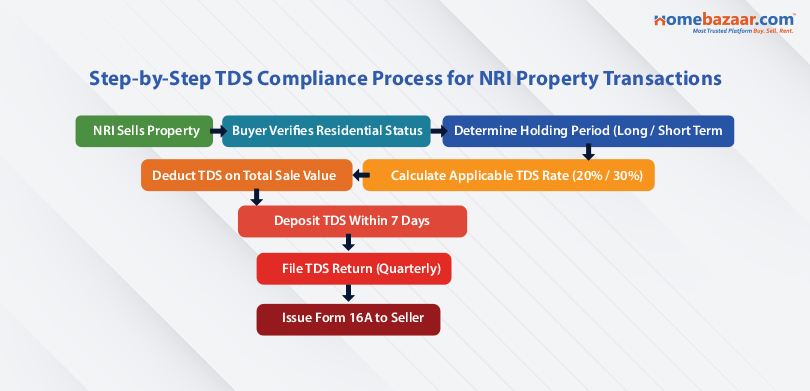
When an NRI sells their property in India, the buyer is legally responsible for deducting TDS before making payment. Unlike regular property transactions, where 1% TDS applies under certain investment thresholds.
NRI transactions attract significantly higher rates under the Income Tax Act. The deduction is governed by the Income Tax Act, 1961 and must be deposited with the Income Tax Department.
This rule applies regardless of whether the property is residential, commercial, or land. Failure to deduct TDS can result in penalties, interest charges, and legal notices to the buyer.
Tax Rates – TDS rules for NRIs purchasing property in Gurgaon

-
Applicable Tax Rates
The TDS rate depends on whether the property being sold is classified as a long-term or short-term capital asset. If the property is held for more than 24 months, it qualifies as a long-term capital asset and attracts 20% TDS (plus surcharge and cess).
If it is held for less than 24 months, it is treated as a short-term capital gain and taxed at slab rates applicable to the NRI seller, often resulting in rates of around 30% plus the applicable surcharge and cess.
This makes understanding TDS on property purchases from NRI sellers extremely important before executing the transaction.
| Holding Period | Capital Gain Type | Base TDS Rate |
| More than 24 months | Long-Term | 20% |
| Less than 24 months | Short-Term | 30% |
| No Lower Deduction Certificate | Default | On Full Sale Value |
-
Example Calculation
If an NRI sells a property in Gurgaon for ₹1.5 crore and it qualifies as a long-term capital gain, the buyer must deduct 20% TDS on the total sale consideration.
This means ₹30 lakh (excluding surcharge and cess adjustments) must be deducted and deposited with the government before transferring the remaining amount to the seller.
-
Responsibility of the Buyer
The obligation to deduct and deposit TDS lies entirely with the buyer. Even if the seller requests full payment, the buyer must comply with tax regulations and opt for TDS deduction.
The buyer must obtain a Tax Deduction Account Number (TAN), deduct TDS at the applicable rate, deposit it within the prescribed timeline, and issue Form 16A to the NRI seller.
Non-compliance may lead to penalties under the Income Tax Act and interest for delayed deposit. These compliance requirements are key components of Income tax rules for NRIs buying property in India.
| Activity | Timeline |
| TDS Deduction | At time of payment |
| Deposit of TDS | Within 7 days from month-end |
| Issue of Form 16A | Within 15 days from the due date |
| Filing TDS Return | Quarterly |
Lower or Nil TDS Certificate
-
When Can It Be Applied?
In many cases, the actual capital gain of the NRI seller may be significantly lower than the standard TDS deduction calculated on the total sale value.
To avoid excess deduction, the NRI seller can apply for a Lower Deduction Certificate under Section 197 of the Income Tax Act.
Once the certificate is issued by the assessing officer, the buyer can deduct TDS at the lower prescribed rate instead of the standard 20% or 30%.
-
Benefit of Lower Deduction
This mechanism prevents unnecessary blockage of funds for the NRI seller and ensures that only actual tax liability is deducted. It also reduces the need for later refund claims.
TDS Deposit Timeline and Filing
After deducting TDS, the buyer must deposit the amount with the government within seven days from the end of the month in which TDS was deducted. The buyer must then file TDS returns and issue Form 16A as proof of deduction.
Proper documentation is very necessary because these records will be required during assessment or future property resale. Compliance also plays an important role in managing NRI property tax in Gurgaon without complications.
Surcharge and Health & Education Cess
In addition to base TDS rates, a surcharge may apply depending on the total income of the NRI seller. Health and education cess at 4% is also added to the tax amount. These additional components increase the effective TDS liability beyond the base 20% or 30%.
Therefore, buyers must calculate TDS carefully and consult a tax professional before finalizing payment structures.
Capital Gains Implications for NRIs
The tax liability ultimately depends on capital gains calculated after considering the indexed cost of acquisition (for long-term assets) and eligible exemptions. NRIs may claim exemptions under sections such as reinvestment in residential property or specified bonds, subject to conditions.
However, unless a lower deduction certificate is obtained, TDS must still be deducted on the total sale consideration. This is why understanding the TDS rules for NRIs purchasing property in Gurgaon is critical before closing any transaction.
Double Taxation Avoidance Agreement (DTAA)
NRIs residing in countries that have a Double Taxation Avoidance Agreement with India may claim relief to avoid being taxed twice on the same income.
The applicability depends on the country of residence and specific treaty provisions. Proper documentation and tax residency certificates are required to claim such benefits.
Common Mistakes to Avoid
One common mistake buyers make is assuming that the 1% TDS rule applicable to resident sellers also applies to NRI transactions. This is incorrect. NRI transactions attract significantly higher deduction rates.
Another mistake is deducting TDS only on the capital gain portion rather than on the total sale value, unless supported by a lower deduction certificate. Buyers must also avoid delaying TDS deposits, as interest penalties accumulate quickly.
Importance of Professional Tax Advice
Given the complexity of NRI property tax in Gurgaon, consulting a chartered accountant or tax advisor is highly recommended. Proper planning ensures compliance, avoids penalties, and prevents unnecessary financial strain on either party.
Understanding the TDS rules for NRIs purchasing property in Gurgaon not only protects the buyer from legal risk but also ensures smooth transaction execution.
FAQs
What is the TDS rate when buying property from an NRI in Gurgaon?
If the property is long-term (held over 24 months), TDS is generally 20% plus surcharge and cess. For short-term holdings, TDS is applied at slab rates, often around 30% plus surcharge and cess.
Who is responsible for deducting TDS?
The buyer is responsible for deducting and depositing TDS before paying the remaining sale consideration to the NRI seller.
Can TDS be reduced?
Yes, if the NRI seller obtains a Lower Deduction Certificate under Section 197, TDS can be deducted at the reduced rate mentioned in the certificate.
Does DTAA apply to NRI property sales?
Yes, NRIs may claim relief under applicable Double Taxation Avoidance Agreements, subject to documentation and eligibility.
Is TDS deducted on the total sale value or only on capital gains?
Unless the NRI seller obtains a Lower Deduction Certificate under Section 197, TDS must be deducted from the entire sale consideration, not just the capital gain amount.
Disclaimer: With 12+ years of experience & expertise in the real estate industry, Homebazaar provides end-to-end property-buying solutions. Hundreds of 100% verified RERA-registered residential & commercial properties are listed on our website. We provide facilities like Zero brokerage, 360° virtual street view, effortless site visit services, end-to-end property buying agreements & documentation guidance, and low-interest home loan assistance. This helped us gain the trust of 1,25,000+ clients across India & sold 9,500+ homes of top reputed developers while saving Rs. 210+ Crores of brokerage.