
Page Contents
Stamp duty and registration charges in Navi Mumbai are impacted by its inclusion in the Mumbai Metropolitan Region (MMR), where an additional 1% Metro Cess applies over the base stamp duty rate.
Current applicable rate:
| Buyer Category | Stamp Duty Rate | Breakdown |
| Male Buyer | 6% | 5% Base + 1% Metro Cess |
| Female Buyer. | 5% | 4% Base (1% concession) + 1% Metro Cess |
| Joint Ownership (Male + Female) | 6% | Standard applicable rate. |
The women’s concession is a Maharashtra Government policy aimed at encouraging property ownership among women. It applies only when the primary buyer is female.
Registration Charges:
Registration is a separate, mandatory charge distinct from stamp duty.
- 1% of the property value, subject to a cap
- Maximum: ₹30,000 for properties valued above ₹30 lakh
Without registration, the sale deed holds no legal validity. It is non-negotiable.
How the Property Value Is Calculated
This is where many buyers get caught off guard.
Stamp duty is not always calculated on the price you agreed to pay. It is levied on whichever is higher, the transaction value or the Government Ready Reckoner value in Navi Mumbai. If the RR value of a property is ₹90 lakh, but you negotiated a deal at ₹80 lakh, the stamp duty is still calculated on ₹90 lakh.
Checking the Ready Reckoner rate for your specific micro-market before finalising a deal is a step most buyers skip and regret later.
- Before execution of the Sale Deed
- Paid online through Maharashtra GRAS (Government Receipt Accounting System)
- Mandatory before booking your registration appointment
There is no flexibility on timing. Delayed or unpaid stamp duty can attract penalties.
The Real Financial Impact
Most buyers plan for the down payment. Very few account for what the government collects before you even get possession.
Assumed property value: ₹1 crore
| Charge | Rate | Amount |
| Stamp Duty (Male Buyer) | 6% | ₹6,00,000 |
| Stamp Duty (Female Buyer) | 5% | ₹5,00,000 |
| Registration Charge | Capped | ₹30,000 |
So for a male buyer, the total statutory outgo is ₹6,30,000 before any other cost kicks in.
This is over and above:
- Down payment (typically 10–20% of property value).
- Home loan processing fees and eligibility criteria.
- Legal and documentation charges.
- Society formation or transfer charges (if applicable).
On a ₹1 crore property, total pre-possession costs can easily cross ₹7-8 lakh, sometimes more, depending on the locality and loan structure.
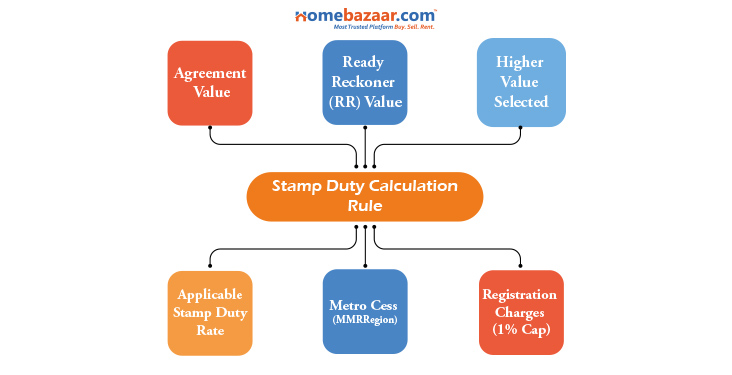
The calculation is not as straightforward as applying a percentage to the sale price. Two values come into play, and the government always picks the higher one.
The basic Rule:
Stamp duty is calculated on whichever is higher.
- Agreement Value: The price agreed between buyer and seller.
- Ready Reckoner (RR) Value: the minimum value set by the Maharashtra Government for that area.
This rule exists to prevent undervaluation and tax evasion.
Penalties for Non-Payment
Unpaid or underpaid stamp duty attracts a penalty of 1% per month, up to a maximum of 200% of the deficit. An underpayment of ₹1 lakh can balloon into a ₹2 lakh liability.
Stamp Duty is not one size fits all. Rates, valuation logic, and compliance requirements shift depending on the type of property and nature of the transaction.
-
Residential Property
Male/Joint Female Stamp Duty 7% 6% Registration 1% (capped at ₹30,000 above ₹30L) Same Includes base duty + Metro Cess (1%) + Local Body Tax (1%).
-
Resale Properties
The stamp duty rate remains the same for a fresh sale. However, valuation works differently. Buying resale property in Navi Mumbai requires extra diligence, as resale prices are often lower than RR values, meaning duty is frequently calculated on RR, not the agreed price.
One critical step most buyers miss is Index II verification at registration.
- Confirm the complete chain of ownership and mutation history.
- Essential for a clear title.
- Directly affects duty computation and dispute resolution.
Skipping Index II on a resale can create legal and financial complications post-registration.
-
Commercial Property
Commercial properties attract a higher duty and a higher RR value, both working against the buyer.
- The stamp duty base rate is typically 8% or higher, depending on zoning and location.
- RR values for commercial use are set higher than residential.
- Registration charge structure remains the same, 1%, capped at ₹30,000.
-
Gift Deed (Family Transfer)
When property is transferred as a gift within the close family:
- Stamp duty: ₹200 flat (for transfers between parent and child or close relatives)
- Registration: standard 1%, capped at ₹30,000
This is one of the most tax-efficient ways to transfer property, yet rarely discussed in the context of Navi Mumbai transactions.
-
Lease Deed
Lease transactions follow a different duty structure entirely:
- Residential lease: 0.25% of total rent and security deposit
- Non-residential lease: typically 5% on total rent and security deposit
Exact figures should be confirmed via the official IGR Maharashtra portal, as municipal rules may apply.
-
Power of Attorney (PoA)
Stamp duty on a PoA depends on:
- The nature of the powers granted
- Whether the PoA involves property transfer or management
- Applicable schedule under the Maharashtra Stamp Act
PoA-based property transactions carry their own compliance risks and are subject to additional scrutiny. Legal advice is recommended before proceeding.
How To Pay and Register Stamp Duty and Registration Charges in Navi Mumbai
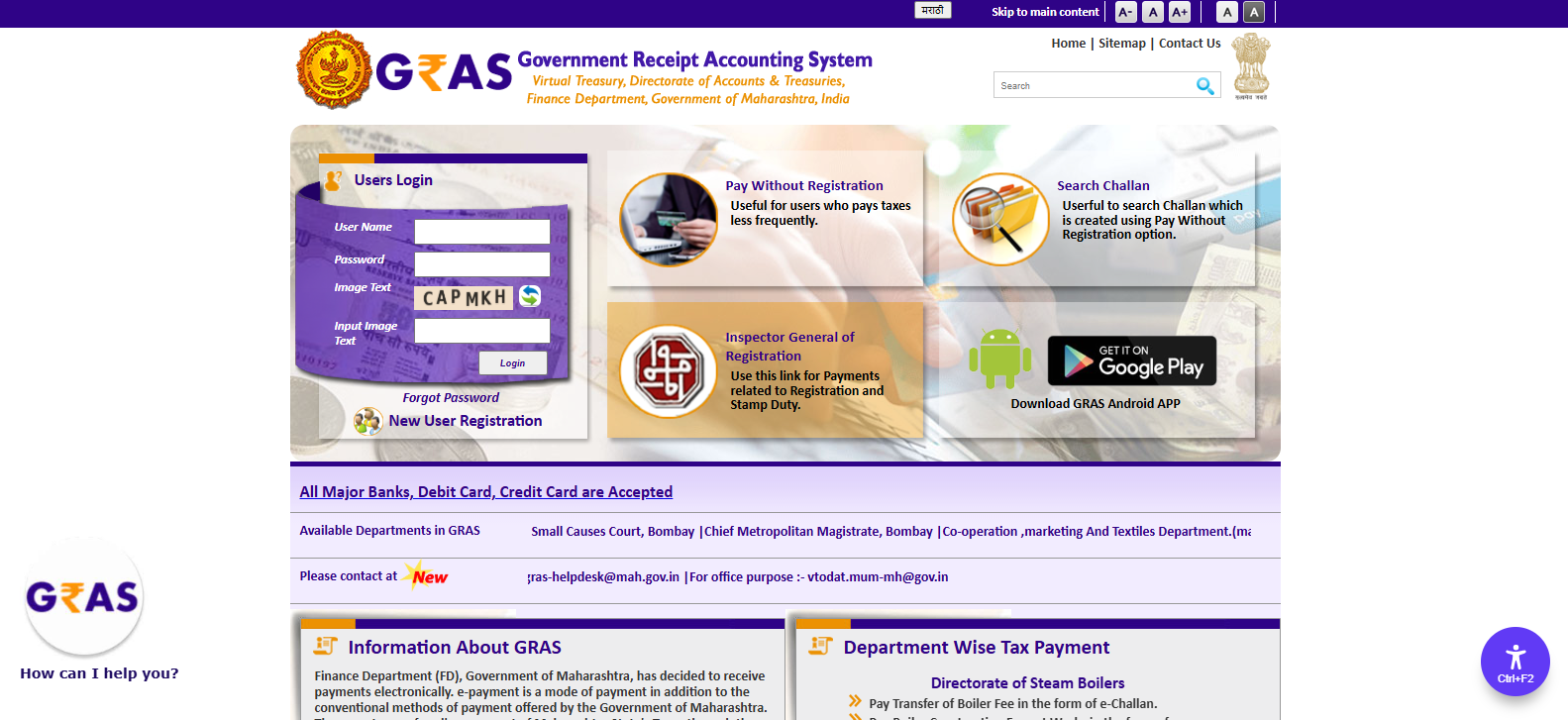
The payment and registration process is largely digital until physical biometric verification at the Sub-Registrar Office. Below is the structured workflow.
Step 1: Calculate the Payable Amount
Use the government official IGR Maharashtra stamp duty Calculator to estimate stamp duty and registration charges in Navi Mumbai.
The calculation is based on the higher of:
- Agreement value.
- Ready Reckoner (RR) value for the property location.
This higher-value rule determines the final statutory liability.
Step 2: Pay via Maharashtra GRAS Portal
Visit the Government Receipt Accounting System (GRAS) portal and:
- Select Inspector General of Registration.
- Choose Pay Stamp Duty or Pay Stamp Duty + Registration Fees.
- Enter district, Sub-Registrar Office (SRO), article type, and property valuation.
- Pay online (net banking/card) or generate an e-challan for bank payment.
- Download the receipt containing the Government Reference Number(GRN).
The GRN is mandatory for document registration.
Step 3: Prepare Documents
Before booking registration, keep ready:
- Sale deed draft (with GRN mentioned).
- PAN of buyer and seller (mandatory under Income Tax rules).
- Aadhaar for identity verification.
- Two witnesses with a valid ID.
- Passport-size photographs.
Incomplete documentation can delay registration.
Step 4: Book Registration Appointment
Use the IGR Maharashtra online appointment system to:
- Select the Sub-Registrar Office.
- Upload required documents.
- Confirm a time slot.
Registration must be completed within 4 months of execution of the sale deed under the Registration Act.
Step 5: Attend Registration
Both buyer and seller must appear at the Sub-Registrar Office for:
- Biometric thumb impression.
- Photograph capture.
- Document verification.
After verification, the document is officially registered.
Step 6: Receive Registered Copy & Index II
Post-registration:
- A digitally signed registered document is issued.
- Index II extract is generated.
Index II serves as public record proof of the registered transaction.
FAQs
What is the current stamp duty in Navi Mumbai?
Stamp duty and registration charges in Navi Mumbai typically total 6% to 7% of property value
for residential transactions in the MMR region.
How are stamp duty and registration charges calculated in Navi Mumbai?
They are calculated on the higher of the agreement value or the Ready Reckoner (RR) value.
Registration charges are generally 1% of the property value, subject to a cap.
Is stamp duty different for female buyers in Navi Mumbai?
Yes, female buyers receive a 1% concession on the base stamp duty rate in Maharashtra, reducing the overall payable amount.
Are stamp duty charges different for resale property in Navi Mumbai?
The percentage remains the same, but stamp duty may increase if the Ready Reckoner value is higher than the resale transaction value.