
It’s truly rewarding for NRIs to invest in Lucknow’s real estate market. However, NRIs should have a proper understanding of legal frameworks. The Real Estate (Regulation and Development) Act, 2016 (RERA), is an important regulation that protects the buyer’s right.
This is a guide that helps understand the RERA rules for NRIs in Lucknow, how they apply, what protection you get, and what to check before buying a property. The RERA rules are the same for residents and non-residents.
Page Contents
What is RERA and Why Does It matter for NRIs?
The RERA Act was introduced to ensure transparency, accountability, and standardisation in the real estate sector in India.
RERA is especially important for NRIs because:
- You may not be physically present for the purchase.
- The dependency on brokers or third parties reduces.
- It makes sure the project information is made public.
- It protects buyers from delays and misleading claims.
RERA Rules for NRIs in Lucknow: Must Know
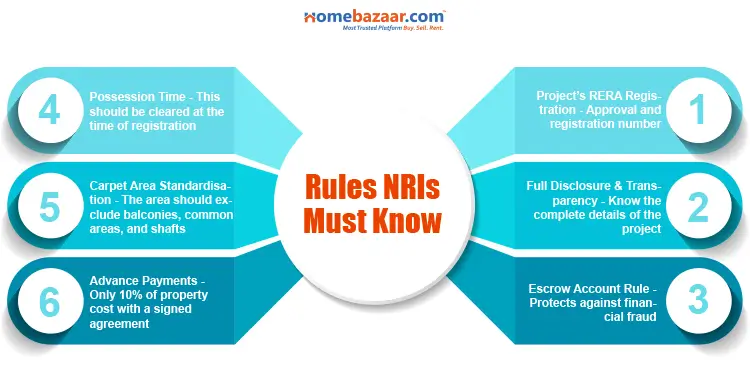
Project’s RERA Registration
Any project, be it commercial or residential and above a certain size, must be registered under RERA. Every project in Lucknow has a unique RERA registration number.
Every state has its separate RERA. So, when you are planning to buy property in Lucknow, always check on UPRERA. All the project details are available there. If the project is not registered with RERA, it’s not safe.
Full Disclosure & Transparency
RERA ensures the developer adds the detailed product information, including:
- Land ownership documents
- Layout plans and building approvals
- Number of units and project phases
- Construction status updates
- Timeline for completion
It benefits NRIs, as they don’t have to rely on the broker or any third party, as all the information is publicly available.
Escrow Account Rule (70% Fund Protection)
This is one of the strongest protections from the RERA. Developers are required to deposit 70% of the project amount in the Escrow account.
This ensures that the funds are only for that specific project, and the chances of fund diversion are reduced.
This rule saves NRIs from delays and abandonment. It also ensures financial discipline from the developer.
Defined Possession Time
The builder must specify a clear possession date at the time of registration. This makes sure the project is delivered on time.
If the project is delayed, the buyer can legally ask for compensation or interest. If if the NRI is not present in India, he/she can remain protected under RERA.
Carpet Area Standardisation
RERA has introduced a uniform definition for carpet areas. It is an actually used area within the apartment. It excludes balconies, common areas, and shafts.
NRIs will know exactly what they are paying for, and it becomes easy to compare between different projects.
Restriction on Advance Payments
Developers can only collect 10% of the property’s cost with a signed sale agreement. If there is no legal backing, advance payments are not permitted.
The rule provides protection to buyers from theft, fraud, and sudden cancellation. An NRI must always ask for a registered agreement before making huge payments.
Defect Liability (5-Year Protection)
It ensures the builder is the sole person responsible for structural defects or poor workmanship. This liability lasts for 5 years. It covers cracked walls, waterproofing problems, and structural faults.
If an NRI is not living in or renting the property out, this rule makes sure that repair costs are covered by the builder themselves.
RERA Compliance Checklist for NRIs
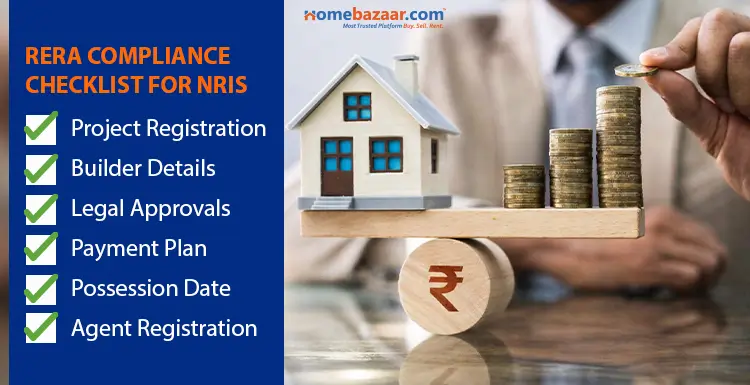
This must be followed before buying a property in Lucknow:
| Checklist Item | What to Verify |
| Project Registration | Check UP RERA number |
| Builder Details | Past projects and track record |
| Legal Approvals | Land title, permissions |
| Payment Plan | Linked to construction stages |
| Possession Date | Clearly mentioned in agreement |
| Agent Registration | RERA-certified broker |
Documents NRIs Should Review Before Purchase
These documents are critical with RERA:
- Sale agreement
- Allotment letter
- Title deed
- Encumbrance certificate
- RERA registration certificate
NRIs Should Take Care of These Things
- Properties that are permitted include residential apartments, villas, and commercial spaces (offices and stores), among other types of buildings.
- The funds must be obtained through legitimate banking channels, specifically through NRE (Non-Resident External), NRO (Non-Resident Ordinary), or FCNR (Foreign Currency Non-Resident) accounts.
- A PAN Card is required at all times as documentation. A Power of Attorney (PoA) is required in the event that you are unable to be present for registration. Other documents include a passport, a visa or work permit, and a driver’s licence.
- There is a requirement for specific approval from the RBI in order to purchase agricultural land, plantation property, or farmhouses; nevertheless, these properties can be inherited.
- Non-resident Indians (NRIs) are able to apply for home loans from Indian banks; however, they are required to make repayments through their NRE or NRO accounts.
- Those payments that are paid to sellers are subject to taxation, specifically Tax Deducted at Source (TDS). Tenant income is subject to taxation in India. When an asset is sold, a capital gains tax is imposed.
Benefits of RERA Rules for NRIs in Lucknow
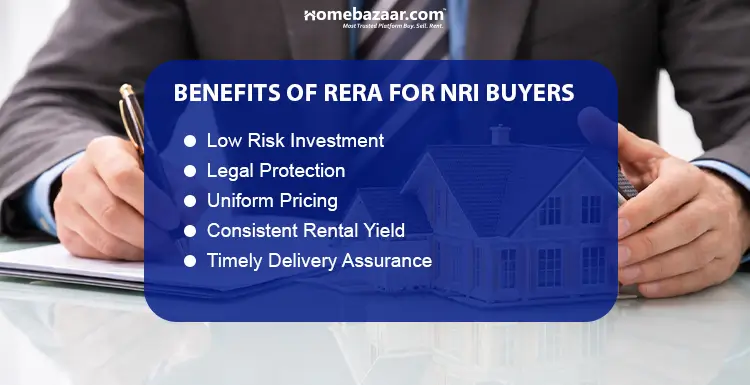
- Lower Risk: Everything about the project is transparent, so frauds are eliminated.
- Legal Protection: If things go haywire, filing online complaints through UP RERA is easy.
- Uniform Pricing: The pricing is decided as per the carpet area to avoid any confusion.
- Timely Delivery Assurance: If the projects are delayed, builders take accountability by paying penalties.
Common Mistakes NRIs Should Avoid
- Not verifying property on RERA.
- Not doing any legal verification.
- Investing in unregistered or pre-launch projects.
- Not checking the builder’s past delivery record.
- Do not rely on a broker or relative without checking yourself.
FAQs
- Is RERA applicable to all properties in Lucknow?
No, only projects above a certain size must be registered. However, most new residential projects fall under RERA.
- Can NRIs file complaints under RERA?
Yes, NRIs have full rights to file complaints through the UP RERA portal.
- Is it safe to invest in pre-launch projects under RERA?
Only if the project is officially registered. Avoid unregistered pre-launch offers.
- What happens if the builder delays possession?
The buyer is entitled to compensation or interest as per RERA rules.
- Can NRIs buy property online under RERA?
Yes, NRIs can buy a property online, as the verification and paperwork are possible online, but a legal review would be helpful.