Page Contents
- What are the Property Taxes in India
- Property Tax on Buying a Property
- GST On Property in India
- Stamp Duty and Registration Charges
- Property Taxes During The Property Ownership
- Property Tax Calculation
- Property Tax on Selling The Property
- How to Save the Property Tax In India
- How To Pay The Property Tax Online
- FAQs
What are the Property Taxes in India
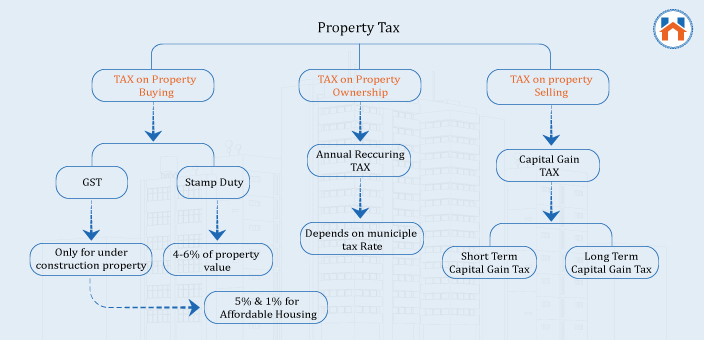
In India, the property tax is applicable as per the Income Tax Act 1961. The tax is applicable while buying the property, during the ownership of the property, and when selling the property.
Here is the general distribution of the applicable property tax in India for buying, selling, and owning the property.
Property Tax on Buying a Property
When you purchase a new property, you need to pay the property tax in India. These taxes are GST and Stamp Duty Registration Charges.
GST On Property in India
GST on property in India is charged only on under-construction properties.
- 1% GST for affordable housing
- 5% GST for other residential properties
No GST is charged on:
- Ready-to-move properties
- Resale or old properties
Also, ITC (input tax credit) is not available on residential property under the current rules.
Highlights-GST On Property in India
| Under-construction property | 1%-5% | 1% for affordable housing and 5% for other residential properties. |
| Ready-to-move property | 0% | No GST after the completion certificate is issued. |
| Commercial property (under construction) | 12% | Higher GST may apply depending on usage. |
Stamp Duty and Registration Charges
Stamp duty and registration charges are mandatory costs you need to pay when buying a property in India. These are government charges and form a major part of the total property cost.
- Stamp duty is a tax charged by the state government on property transactions.
- Registration charges are paid to register the property in your name.
| Charge Type | Rate | Details |
| Stamp Duty | 2% to 7% | Depends on the state location and property value. |
| Registration Charges | Around 1% | Paid to the sub-registrar’s office. |
In total, these charges can add around 5% to 10% of the property value to your overall cost. The exact property tax rate in India for stamp duty varies by state and is calculated based on the property value or circle rate, whichever is higher.
Stamp Duty and Registration Charges in Major Cities
| City | Male | Female |
| Mumbai | 5% | 4% |
| Navi Mumbai | 6% | 5% |
| Thane | 6% | 5% |
| Pune | 7% | 6% |
| Bangalore | 3%-5% | Same as male |
| Chennai | 7% | 7% |
Stamp duty rates may vary based on property value location, and state rules. The above data is indicative and can change as per government updates.
Property Taxes During The Property Ownership
Once you own a property, you may need to pay annual property tax. to the local municipal authority. This is one of the main property tax in India and is used for services like roads, drainage and public infrastructure.
Property tax applies to:
- Residential properties
- Commercial properties
- Rented or vacant properties
The amount is decided by the municipal body based on factors like property size, location usage, and value.
What is Included in Property Tax
Property tax is not just one charge. It includes multiple small components, such as:
- General tax.
- Water tax.
- Sewerage and drainage charges.
- Lighting or infrastructure charges.
These components may vary from city to city depending on local municipal rules.
| Factor | Details |
| Type of tax | Annual municipal tax |
| Who collects it | Local municipal authority |
| Payment frequency | Yearly or half-yearly |
| Depends on | Location, size, usage and property value |
Property Tax Calculation
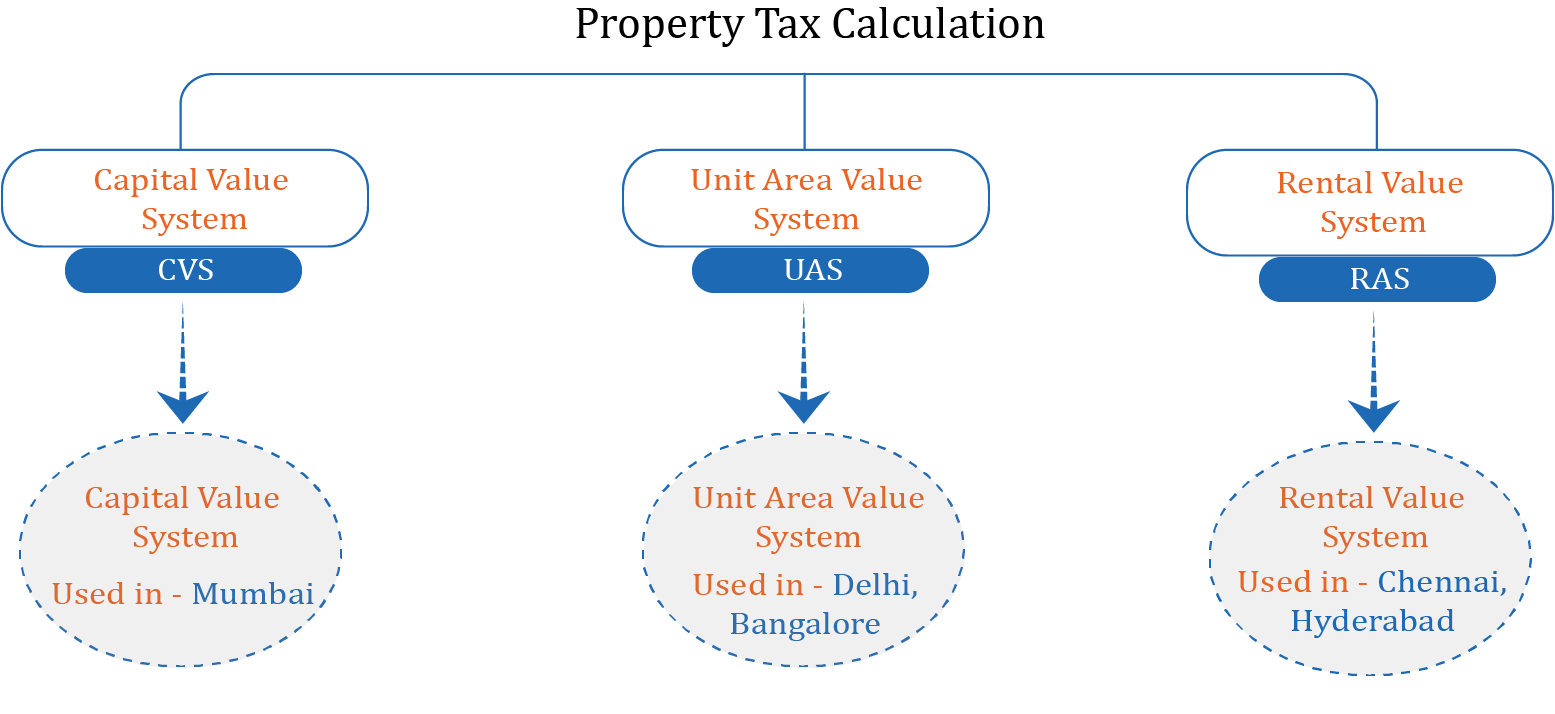
The property tax is calculated by the municipal authorities of the specific region. Different municipal authorities have used different property tax calculation methods.
Generally, the property tax in India is calculated based on the following three methods.
Capital Value System (CVS)
The Capital Value System is used in Mumbai. In this method the Capital Value System (CVS) the annual property tax is computed based on the Market value of the property. In Mumbai, the Ready Reckoner rates are considered the market value of the property. The Municipal corporation releases the ready reckoner rates every year.
The Property Tax formula can be given as-
Property Tax = Capital Value X Property Tax Rate
The formula to calculate the capital value-
Capital Value For Land
Capital Value (CV) = BV x UC x FSI x AL
Where,
BV = Base Value As per Ready Reckoner Rate
UC = User Category
FSI = Floor Space Index
AL = Area of Land
Capital Value for the Flats can be calculated as
Capital Value (CV) = BV x UC x NTB x AF x FF x CA
Where:
BV = Base Value As per Ready Reckoner Rate
UC = User Category
NTD = Nature and Type of Building
AF = Age of the Building
FF = Floor Factor
CA = Carpet Area
Example For Calculating the Property Tax on a Flat
Consider the following property details to calculate the applicable property tax with the Capital Value System (CVS)
Ready Reckoner Rate = Rs 50,000/ Sq mt
User Category = Residential Property (0.5)
NTB = 1 For RCC building
AF = 0.95 Age Factor 9-10 years Old Building
FF = 1.0 (1-4 Floors)
Carpet Area = 100 Sq mt
TAx Rate for Residential Properties in Mumbai = 0.755%
So the capital value will be
Capital Value (CV) = BV x UC x NTB x AF x FF x CA
= 50,000 X 0.5 X 1 x 0.95 X 1 X 100
= Rs 23,75,000
Total Property Tax = 0.755% of 23,75,000
= Rs 17,931
Unit Area Value System (UAVS)
The Unit Area Value system is the modern method for calculating property tax. It does not depend on the market value or the rental value of the property and, therefore, gives an accurate calculation of the property taxes.
This method for calculating the property considers the age of the property, the location of the property, and the type of the property.
In the unit area value system, the localities are categorized based on livability ratings.
Property Tax Calculation Formula by Unit Area Value System
Property Tax = Annual Value X Tax Rate
The Annual Value can be calculated as
Annual Value = Area Covered X UAV X Use Factor X Age Factor X Structure Factor X Occupancy Factor X Flat Factor
Where,
UAV = Unit Area Value per Square Meter; it depends on the property category. (Between 100- 630) (Categories AH)
Use Factor = It is the factor assigned based on the property use. Between 1-10, for residential property, it is 1
Age Factor = Depends on the age of the property. New properties have a higher age factor. Usually between 0.5 and 1
Occupancy Factor = Depends on whether the property is for self-use or has been rented out. Occupancy Factor 0.6-2
Flat Factor = It is the total area covered by the flat.
Area Covered = Indicates the total area covered by the property.
The Tax rate depends on the total categories made by the multiple authorities. In Delhi, the Tax rate is between 7-20% of the annual value of the property.
Consider an example- You own a flat in Delhi with a UAV of Rs 400, Category C, and the total area of the property is 90 sq meters. You purchased the property in 2002. And you are using the property for your own use.
In this case-
UAV = Rs 400 per sq ft
Use Factor = 1.0 since it is residential property
Age Factor = 1.0 since the property was bought after 2000
Structure Factor = 1.0 for RCC Building
Occupancy Factor = 1.0 for self-occupied
The property tax can be calculated as-
Property Tax = Annual Value X Tax Value
Annual Value = Area Covered X UAV X Use Factor X Age Factor X Structure Factor X Occupancy Factor
= 90 X 400 X 1 X 1 X 1 X 1
= Rs 36000
The Property Tax rate for residential properties is 11% in Delhi for Category D localities.
Therefore,
Property Tax = Rs 36000 X 0.11
Property Tax = Rs. 4356
Annual Rental Value System (ARV)
This method calculates the property tax by considering the annual rental value of the property. The municipal authority does the calculation of the rental value of the properties depending on the location, age of the property, and the total area of the property.
This method is used in major cities such as Chennai and Hyderabad.
Property tax = NARV X Tax Rate
Where NARV is the rental value of the property, which depends on multiple factors defined by the municipal corporation of the region.
Property Tax on Selling The Property
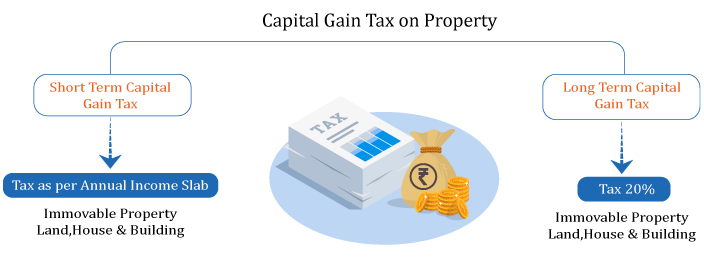
The Tax is also applicable to the profit you get after selling the property. This property tax is also called the capital gain tax.
The capital gain tax on the property is classified into two categories: Short-Term Capital Gains and Long-Term Capital Gains.
Short Term Capital Gain Property Taxes
If the property is sold within the applicable holding period under current tax law, gains may be treated as short-term capital gains.
If you buy the property and sell it within 2 years of purchase, then the profit you get from this deal is subject to short-term capital gain property tax.
In this case, the tax is calculated as per the income tax slabs prefixed by the Income Tax Department.
Long Term Capital Gain Property Tax
If the holding period for the property is less than 2 years, then the tax applicable is termed the short-term capital gain tax.
If you sell the property after 2 years, then the profit you get is subject to the long-term capital gain taxes.
In this case, long-term capital gains tax may apply as per prevailing income tax rules.
How to Save the Property Tax In India
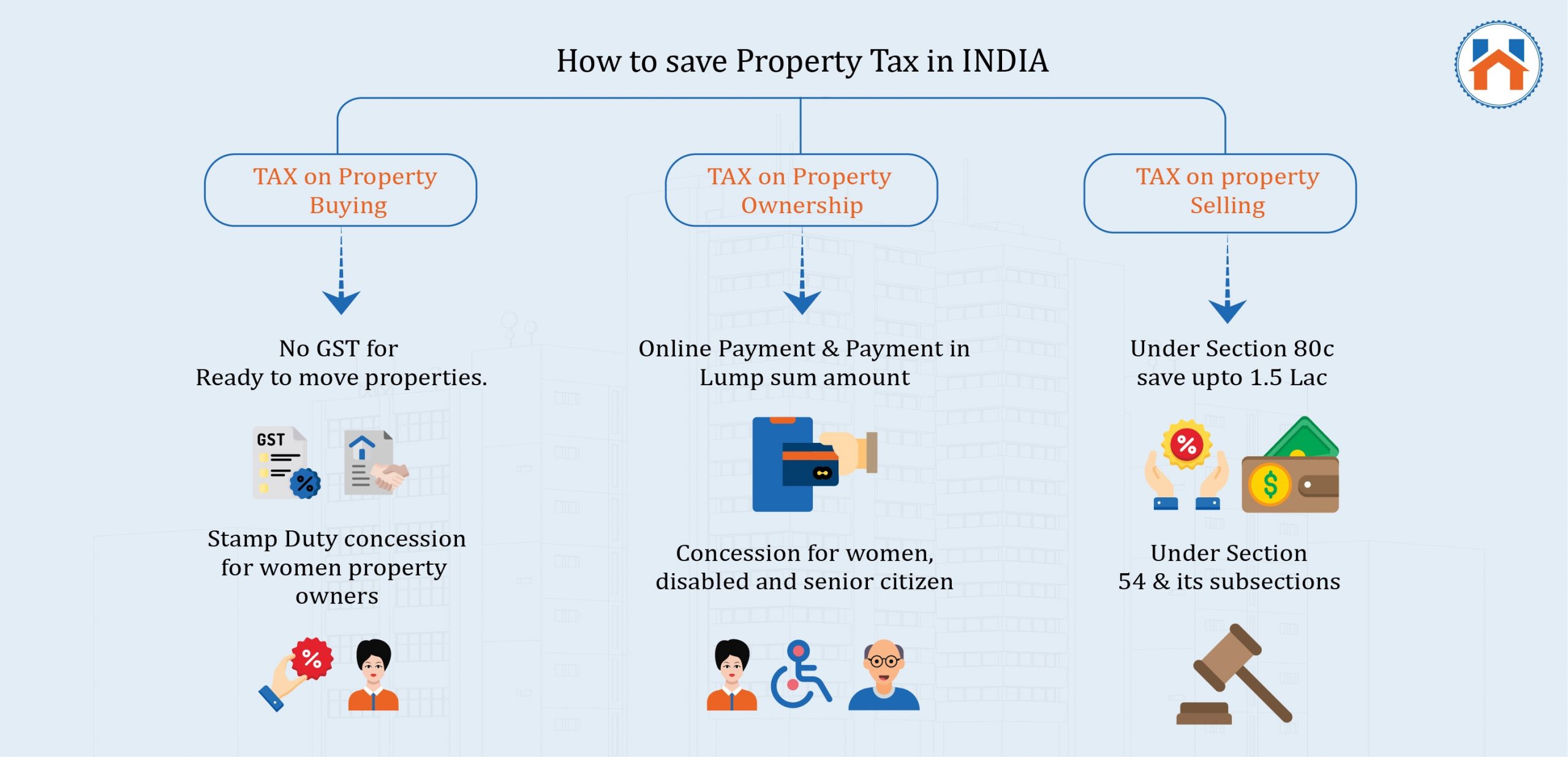
There are legal provisions that can help you save a considerable amount of property taxes.
As we have categorized the property tax into three segments, let’s check what are the tax-saving provisions available for all three types.
How To Save Tax on Property Buying
When buying a property in India you may be able to reduce some taxes legally with proper planning. The biggest charges at the buying stage are GST and stamp duty.
Ways to Save Tax While Buying Property
- Choose a ready-to-move property.
GST is generally not applicable to completed ready-to-move properties with a completion certificate. Under-construction homes attract GST. - Buy under the affordable housing category.
Eligible affordable housing projects attract a lower GST rate than regular under-construction housing. - Check the women buyer stamp duty concessions.
Many states offer lower stamp duty for women buyers. For example, le some states provide 1% to 2% concession. - Use government rebates or temporary concessions.
Some state governments announce time-based stamp duty relief or special category rebates. Always check the latest local rules before registration. - Register at the correct guideline value.
Ensure the transaction follows the official circle rate or the ready reckoner rules to avoid future penalties.
| Tax Type | How to save |
| GST | Buy a ready-to-move property or an eligible affordable housing. |
| Stamp Duty | Check women buyer concessions and state rebates. |
| Registration Cost | Watch for state-specific relief schemes. |
Saving on property tax in India depends on the property type, state rules and buyer profile. Even a small concession can reduce your total buying cost significantly.
How to save the property Tax on Ownership
Once you own a property you need to pay annual property tax to the municipal authority. Many cities offer rebates for early payment or online payment.
| Method to Save Tax | Benefit |
| Early full payment | Some cities offer a rebate if the tax is paid before the due date. |
| Online payment | An extra discount may be available for digital payment in selected cities. |
| Eco-friendly property features | Some municipalities offer concessions for rainwater harvesting, solar systems etc. |
| Pay on time | Helps avoid late payment penalties and interest charges. |
| Check local schemes | Some cities launch seasonal rebate schemes from time to time. |
Property tax benefits depend on city rules and municipal policies. Always check the official local authority website before payment.
How to Save the Property taxes on Selling the property
When you sell a property in India you may have to pay capital gains tax. This depends on the holding period and profit earned after sale. In many cases you can reduce tax legally by reinvesting under eligible sections of the Income Tax Act.
Way to Save Tax After Selling Property
| Method | Benefit |
| Buy another residential property | Long-term capital gains exemption may be available under Section 54 if the eligible conditions are met. |
| Invest in 54EC bonds. | Capital gains can be exempt up to prescribed limits by investing in notified bonds within the timeline. |
| Use Capital Gains Account Scheme (CGAS) | Helps claim exemption if a new property purchase is pending within the allowed period. |
| Keep sales and purchase records | Helps calculate correct gains and avoid excess tax. |
| Plan holding period before sale | Longer holding may qualify for long-term capital gains treatment depending on applicable rules. |
Important Types of Capital Gains
| Type | Meaning |
| Short Term Capital Gain | Property sold within the applicable short holding period. |
| Long Term Capital Gain | Property sold after the applicable holding period with possible exemption options. |
Important Note: Capital gains tax rules can change based on budget updates, ownership type and date of purchase. It is best to consult a tax expert before selling property.
How To Pay The Property Tax Online
You can pay property tax online through the official website of your city’s municipal corporation.
Steps to Pay Online
- Visit the official municipal website.
- Open the Property Tax section.
- Enter Property ID or owner details.
- Check the tax amount.
- Pay through UPI card or net banking.
- Download payment receipt.
Major City Portals
Always use the official website only. Some cities may offer rebates for online payment.
Disclaimer: With 12+ years of experience & expertise in the real estate industry, Homebazaar provides end-to-end property-buying solutions. Hundreds of 100% verified RERA-registered residential & commercial properties are listed on our website. We provide facilities like Zero brokerage, 360° virtual street view, effortless site visit services, end-to-end property buying agreements & documentation guidance, and low-interest home loan assistance. This helped us gain the trust of 1,25,000+ clients across India & sold 9,500+ homes of top reputed developers while saving Rs. 210+ Crores of brokerage
FAQs
| How is property tax calculated in India? There is no fixed national rate. Property tax in India depends on the city, property size, usage type, and municipal rules. Each local authority decides the tax amount. |
| What is the property tax rate in India? The property tax rate in India varies from one city to another. Some cities use unit area value, annual rental value, or capital value systems to calculate tax. |
| Who has to pay property tax in India? The legal owner of the property has to pay property tax in India. It applies to residential, commercial, rented, and in some cases vacant properties. |
| Can I pay property tax online in India? Yes. Most municipal corporations in India allow online payment through their official portals using Property ID, owner details, UPI, net banking, or cards. |
| What happens if property tax is not paid on time? Late payment may lead to penalties, interest charges, and outstanding dues. Some municipal bodies may also restrict certain property-related services until dues are cleared. |