Disclaimer:
With 11+ years of experience & expertise in the real estate industry, Homebazaar provides end-to-end property-buying solutions. Hundreds of 100% verified RERA-registered residential & commercial properties are listed on our website. We provide facilities like Zero brokerage, 360° virtual street view, effortless site visit services, end-to-end property buying agreements & documentation guidance and low-interest home loan assistance. This helped us gain the trust of 55,000+ clients across India & sold 6,500+ homes of top reputed developers.
Page Contents
- What is FSI in Bangalore? How Does It Affect the Value of Property?
- Importance Of FSI In Bangalore
- What Are The New FSI Rules In Bangalore 2026?
- How To Calculate FSI In Bangalore?
- What Is FSI For Residential Buildings In Bangalore?
- What Is FSI For High-Rise Buildings In Bangalore?
- FSI For 30 Feet Road In Bangalore
- FSI For 40 Feet Road In Bangalore
- Premium FAR Charges In Bangalore
- What is Permissible FSI in Bangalore?
- Impact of FSI/FAR on Bangalore’s Real Estate
- FAQs
What is FSI in Bangalore? How Does It Affect the Value of Property?
FSI, or Floor Space Index, is a crucial parameter in deciding the permissible built-up area of the property in Bangalore.
FSI considers the total covered area of all floors, but explicitly excludes basements used for parking, electrical equipment, and designated utility areas.
It is the ratio of the property’s built-up area to the total area of the plot it stands on. Higher the permissible FSI, the more area can be constructed as a build-up area. This uplifts the property value.
Standard FSI in Bangalore ranges from 1.25 to 3.25, but can reach up to 4.8 or 5.2 along Metro and Transit-Oriented Development (TOD) corridors through Premium FAR (Floor Area Ratio) purchases.
The local government determines FSI regulations in Bangalore, and they vary based on the type of property, the road width, and other factors.
In Bangalore, FSI is a crucial factor in determining a property’s market value and possibility for growth.

Before investing in a certain property, developers and investors should take the FSI requirements and other relevant considerations into account.
They can increase their earnings while also promoting the city’s general development by doing this.
In general, a higher FSI in Bangalore means that more built-up area is allowed on a property, which could potentially increase its value.
However, it is important to note that higher FSI may also lead to more congestion and strain on local infrastructure.
In addition, the FSI regulations in Bangalore can be complex and subject to change, which can impact the value of a property.
Note:
Homebazaar serves homebuyers searching for flats in Bangalore with end-to-end services like site visits, and lower-interest home loans to property registration guidance. We provide the best price options & offers for 1 to 4 BHK RERA-registered flats, villas & penthouse properties in Bangalore. To begin a smooth homebuying journey with us, fill out the form mentioned below or on the right side.
Importance Of FSI In Bangalore
FSI, or Floor Space Index, is an important parameter in determining the permissible built-up area of the property in Bangalore.
It is a crucial tool used by the local government to regulate real estate development and ensure sustainable growth in the city.
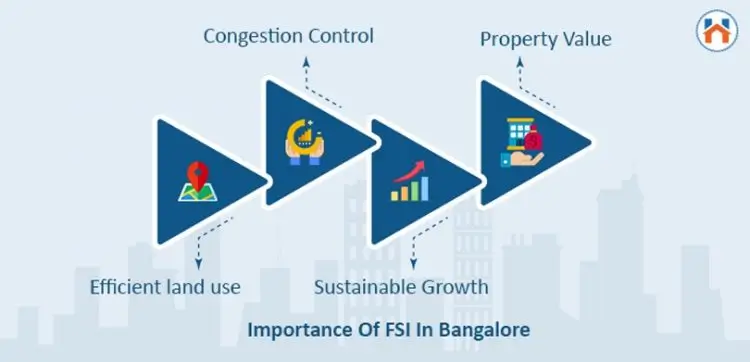 Here are some of the key reasons why FSI is important in Bangalore:
Efficient land use: FSI regulations ensure that the available land in Bangalore is used efficiently and optimally. By limiting the built-up area on the property based on its size and other factors, FSI regulations help to prevent overdevelopment and congestion.
Congestion control: FSI regulations play a key role in controlling congestion and traffic in Bangalore. By limiting the built-up area on a property, FSI regulations can help ensure that there is sufficient open space and infrastructure to support the development.
Sustainable growth: FSI regulations also help to promote sustainable growth in Bangalore. By limiting the built-up area on a property, FSI regulations can help to ensure that there is sufficient green space and other amenities to support the local community.
Property value: FSI regulations can also have a significant impact on the value of a property in Bangalore. A higher FSI may allow for a more built-up area, potentially increasing the property’s value. However, it is important to note that FSI regulations can also change over time, which can impact the value of a property.
Real estate investors and buyers must understand FSI regulations and their impact on Property value before making any investments.
What Are The New FSI Rules In Bangalore 2026?
The Bangalore Building Bye-Laws and the BBMP are in charge of regulating FSI laws and regulations in Bangalore.
For Open Space: Every room meant for human occupancy must have an interior or external open area adjacent to it, or an open verandah that leads to one.
Municipal building regulations specify exact setback distances, plot coverage limits, and FAR allowances across diverse building types, including residential, commercial, public, and semi-public properties.
The Bangalore Development Authority (BDA) divides the local planning area into Ring Zone 1 (Core Area), Ring Zone 2 (Inner Urban Area), and Ring Zone 3 (Outer Urban Area) to regulate construction density.
The plan’s allocated corridors and lobby spaces must be taken into account for FAR.
The FAR applied to the appropriate width of the road shall apply when buildings do not front the required-width roads indicated against each.
The FAR shall only be limited to the limit allowed for the area of a site where that site faces a broader roadway than the one specified against it.
How To Calculate FSI In Bangalore?
The location of the site, the type of building being built, the zoning laws, and the proximity of facilities like water, electricity, and sewerage are just a few of the variables that affect your FSI calculation in Bangalore.
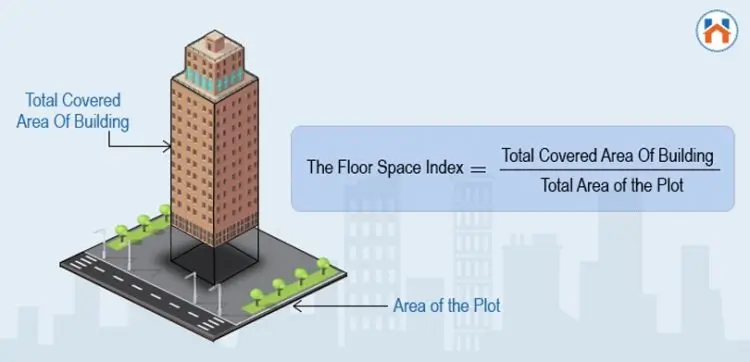 The FSI estimate is further impacted by the building’s height, setbacks, and road width.
You can calculate FSI in Bangalore using the following formula:
|
FSI = Total Covered Area Of Building _____________________________________ Total Area Of Plot |
What Is FSI For Residential Buildings In Bangalore?
In Bengaluru, planning sectors are officially categorized into three distinct geographical bands: Ring Zone 1 (Core Area), Ring Zone 2 (Inner Urban), and Ring Zone 3 (Outer Urban).
The base FSI or FAR in Bangalore ranges between 1.25 and 4.0, dynamically determined by this local ring classification, the plot dimensions, and the adjacent road width.
The FSI is determined for the residential properties by dividing the overall built-up space by the plot area.
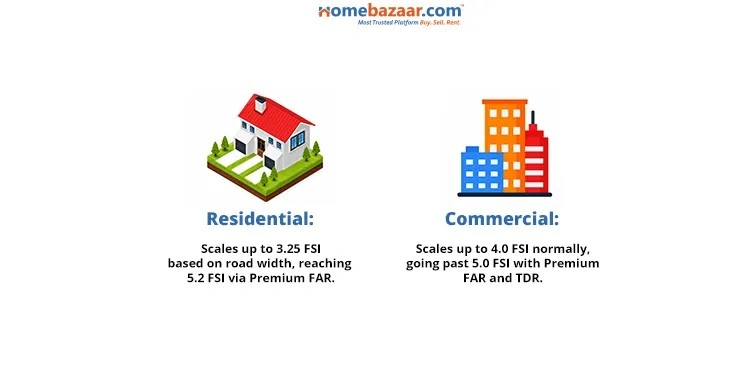
Depending on the zone, plot size, and road width, residential properties in Bangalore have a base FSI ranging from 1.25 to 3.25.
Calculated using the identical formula, the baseline FSI for commercial properties in Bangalore varies from 1.5 to 4.0, heavily influenced by the plot size and the zone.
What Is FSI For High-Rise Buildings In Bangalore?
FSI for high-rise buildings in Bangalore determines the maximum floor area that can be built on a particular piece of land.
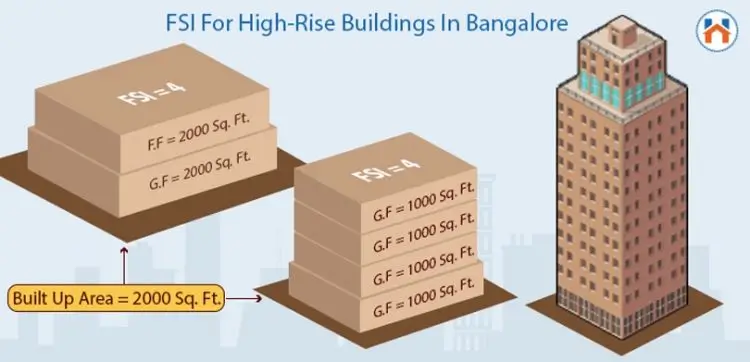 A site hosting a high-rise building must feature a minimum road frontage and plot width of 12 metres, ensuring adequate access for emergency vehicles.
The minimum road width in front of a tall building must be 12 metres.
The FSI for high-rise buildings in Bangalore varies depending on the location and zoning regulations of the area.
In highly connected corridors of Bangalore, the cumulative FSI for high-rise buildings can reach up to 4.8 or 5.2 when baseline metrics are strategically combined with Premium FAR purchases.
However, it’s important to note that FSI is not the only factor that determines the height and size of high-rise buildings in Bangalore.
Other factors such as setbacks, building codes, and fire safety regulations also play an important role in determining the maximum height and size of buildings in the city.
FSI For 30 Feet Road In Bangalore
The FSI for a 30-foot road in Bangalore would depend on the specific zoning regulations and development plan of the particular area.
The FSI for different zones in Bangalore can vary significantly based on factors such as land use, building type, and road width.
In general, the FSI for a 30-foot road in Bangalore is likely to be lower than that for a wider road because the available land area for construction would be comparatively smaller.
However, the actual FSI for a specific area can only be determined by referring to the applicable zoning regulations and development plan of that area.
FSI For 40 Feet Road In Bangalore
The FSI for a 40-foot road is higher than that for a narrower road because wider public roads provide better infrastructure capacity to support higher vertical density safely.
The FSI in Bangalore for a 30 x 40 plot can be calculated using plot area, setback, and other factors defined by BBMP Bangalore Building by law.
Here is the calculation to determine the FSI of a 30 x 40 plot,
30 x 40 sq ft = 1200 sq ft
Determine the setbacks necessary to comply with the BBMP building’s bye laws.
Setbacks do not reduce the geographical plot area for calculation. Instead, BBMP rules dictate that the total plot area of 1,200 sq ft is multiplied by the locally permitted FSI factor to define the absolute maximum ceiling of allowable built-up space across all floors.
According to BBMP laws, the allowable built-up footprint for a 30 x 40-foot plot changes dynamically depending on the local Ring Zone classification and the exact width of the abutting road.
Premium FAR Charges In Bangalore
Following various draft iterations dating back to 2017, the Karnataka government officially gazetted and operationalized the finalized Premium FAR guidelines in February 2025.
The government structured these changes based on extensive frameworks submitted by the Urban Development Department (UDD) and local municipal planning authorities.
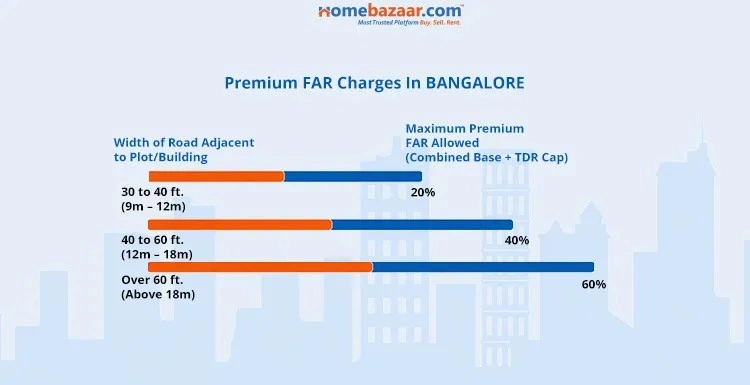
The newly operationalized guidelines limit Premium FAR purchases directly from the government to a maximum of 40% over the standard permissible base FAR, with an option to load an additional 20% specifically through Transferable Development Rights (TDR) on wider roads.
Across all zones in Bangalore, a minimum road width of 9 metres (approx. 30 feet) is a strict mandatory baseline required to qualify for any Premium FAR allocation.
Premium FAR charges in Bangalore apply to high-density projects like high-rise buildings, providing a mechanism for developers to legally exceed baseline constraints. This fiscal levy is officially collected by local planning authorities to fund city-wide infrastructure upgrades.
Under the updated rules, plots on roads 30 to 40 feet wide qualify for up to 20% Premium FAR, roads 40 to 60 feet wide allow up to 40% Premium FAR, and roads over 60 feet wide allow a maximum combined expansion of up to 60% when integrating TDR.
| Width of Road Adjacent to Plot/Building | Maximum Premium FAR Allowed (Combined Base + TDR Cap) |
| 30 to 40 ft. (9m – 12m) | 20% |
| 40 to 60 ft. (12m – 18m) | 40% |
| Over 60 ft. (Above 18m) | 60% |
What is Permissible FSI in Bangalore?
Permissible FSI in Bangalore is described as the maximum amount of floor space that a developer is allowed to build on any given land parcel.
While smaller plots have lower baseline caps, the standard permissible base FAR across Bangalore scales up to 3.25 for large residential plots and up to 4.0 for commercial parcels, depending entirely on extensive plot size and road access limits.
Impact of FSI/FAR on Bangalore’s Real Estate
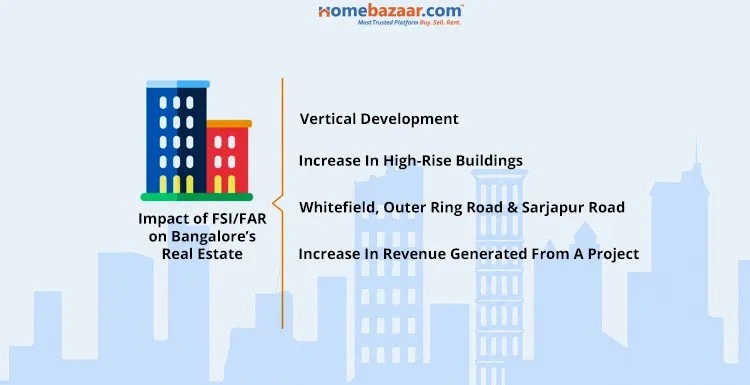
- The Floor Space Index (FSI) has a crucial impact on the real estate landscape in Bangalore. FSI determines the maximum floor area that can be built on a particular plot of the land parcel, and therefore, it has a direct impact on the development potential and profitability of real estate projects in the city.
- In recent years, the FSI in Bangalore has been revised upwards in many areas to promote vertical development and accommodate the growing demand for housing and commercial space. This has led to an increase in the number of high-rise buildings in the city, particularly in areas such as Whitefield, Outer Ring Road, and Sarjapur Road.
- Higher FSI also means that developers can build more floors on a given piece of land, which can increase the number of units that can be constructed and thus, potentially increase the overall revenue generated from a project.
- However, the impact of FSI on Bangalore’s real estate landscape is not entirely positive.
- The increase in high-rise buildings has also led to concerns about infrastructure overload, traffic congestion, and strain on the existing civic amenities.
- In addition, the high cost of land and construction means that developers may prioritize luxury or premium projects, which may not address the affordable housing needs of the city.
In summary, the FSI plays a crucial role in shaping the real estate landscape in Bangalore, and while it has contributed to the development of the city, it also poses significant challenges that need to be addressed.
FAQs
| What is FSI and how is it calculated in Bangalore?
FSI is a ratio that determines the maximum floor area that can be constructed on a plot of land. In Bangalore, Karnataka, FSI is determined by dividing a building’s total built-up area by the size of the land plot on which it is situated. |
| What are the current FSI regulations for high-rise buildings in Bangalore?
The FSI regulations for high-rise buildings in Bangalore vary based on the location and zoning regulations of the area. Depending on the zone and proximity to transit corridors, the overall achievable FSI for high-rises can now reach up to 4.8 or 5.2 when blending base allowances with Premium FAR. |
| How can FSI affect the development potential of a real estate project in Bangalore?
FSI directly impacts the development potential of a real estate project in Bangalore, as it determines the maximum floor area that can be constructed on a given plot of land. A higher FSI can increase the number of units that can be constructed and potentially increase the overall revenue generated from a project. |
| What is the relationship between FSI and road width in Bangalore?
The FSI for a particular area in Bangalore may be influenced by the road width. Generally, a wider road may allow for a higher FSI, as it may provide more space for the construction. |